
Salary vs Dividends: What Directors Should Review Each Tax Year
For many owner-managed companies, the annual question is familiar: how much should the director take as salary, and how much should be extracted as dividends? 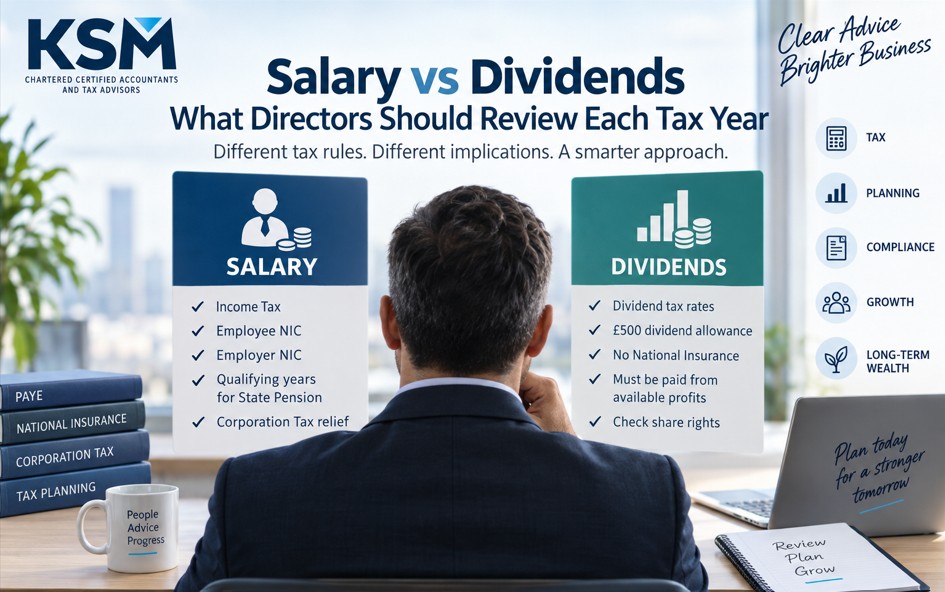
Historically, many shareholder-directors have followed a relatively simple formula of taking a modest salary and drawing the remaining income as dividends. That approach can still be appropriate, but it should no longer be treated as an automatic answer.
For the 2026/27 tax year, the interaction between Income Tax, National Insurance, dividend tax, Corporation Tax, Employment Allowance, the director’s other income and the company’s available distributable reserves all need to be considered.
There is also an important distinction that is sometimes overlooked: salary is paid to a director in their capacity as an employee or office-holder, whereas a dividend is paid to them in their capacity as a shareholder. The tax and legal treatment of the two are therefore fundamentally different.
Why this matters
For an owner-managed company, remuneration planning affects both sides of the equation.
At company level, salary and employer’s National Insurance can normally reduce taxable trading profits where the remuneration is incurred wholly and exclusively for the purposes of the trade. Dividends, by contrast, are distributions of profits and are not deductible when calculating Corporation Tax. HMRC’s guidance confirms that normal employee and director remuneration will generally be allowable, subject to the normal rules governing deductibility.
At personal level, salary may be subject to PAYE Income Tax and employee National Insurance, while dividends are taxed under a separate set of dividend rates and do not attract National Insurance.
The correct comparison is therefore not simply:
“20% salary tax versus 10.75% dividend tax.”
The analysis should consider:
- the Corporation Tax saving generated by salary;
- employer’s National Insurance;
- employee’s National Insurance;
- the shareholder’s marginal Income Tax rate;
- dividend tax;
- the availability of the Personal Allowance;
- Employment Allowance eligibility;
- whether the director needs a qualifying year for State Pension purposes;
- the company’s actual distributable reserves; and
- the director’s wider income position.
The 2026/27 tax position
For 2026/27, the standard Personal Allowance remains £12,570. For taxpayers in England, Wales and Northern Ireland, the basic-rate band remains £37,700 after allowances, meaning the higher-rate threshold is generally reached once total income exceeds £50,270, subject to the taxpayer’s circumstances. The Personal Allowance begins to be withdrawn where adjusted net income exceeds £100,000.
Dividend taxation changed from 6 April 2026.
For 2026/27, dividend income above the available Personal Allowance and £500 dividend allowance is generally taxed at:
- 10.75% where it falls within the basic-rate band;
- 35.75% where it falls within the higher-rate band; and
- 39.35% where it falls within the additional-rate band.
The £500 dividend allowance remains in place.
This means dividend extraction has become more expensive for basic-rate and higher-rate taxpayers compared with 2025/26.
Salary and National Insurance
For the 2026/27 tax year, the main employee National Insurance thresholds include:
- Lower Earnings Limit: £6,708 per year;
- Primary Threshold: £12,570 per year;
- Upper Earnings Limit: £50,270 per year.
For most employees, including directors under the usual category A treatment, employee National Insurance is charged at 8% between the Primary Threshold and Upper Earnings Limit and 2% above that level.
Employer’s National Insurance is more significant.
For 2026/27, the Secondary Threshold is £5,000 per year and the standard employer National Insurance rate is 15% above that threshold.
This creates an important planning point.
A director receiving a salary of £12,570 may have no employee National Insurance liability if there is no other relevant employment income, but the company could still incur employer National Insurance because the salary exceeds the £5,000 Secondary Threshold.
On a £12,570 annual salary, the potential employer National Insurance before any Employment Allowance would broadly be:
£12,570 – £5,000 = £7,570
£7,570 × 15% = £1,135.50
That cost must be included when comparing salary with dividends.
Employment Allowance can change the answer
The Employment Allowance for 2026/27 is £10,500 for eligible employers. It can reduce an employer’s Class 1 National Insurance liability.
However, not every owner-managed company can claim it.
A limited company generally cannot claim Employment Allowance where it has only one director and that director is the only employee liable for secondary Class 1 National Insurance. HMRC’s guidance specifically addresses this restriction.
This means two otherwise identical companies may reach different conclusions about the optimum director salary.
For example:
Company A has one director and no other employees. It may not be eligible for Employment Allowance.
Company B has several genuine employees and satisfies the Employment Allowance conditions. Its employer National Insurance on the director’s salary may effectively be covered by the allowance, subject to the company’s overall employer NIC liability.
The appropriate salary therefore needs to be calculated for the company concerned rather than copied from a generic annual “best director salary” table.
Corporation Tax also matters
Salary and employer National Insurance are generally business expenses and can reduce taxable company profits where the relevant tax conditions are satisfied.
For the financial year beginning 1 April 2026, the main Corporation Tax rate remains 25%. The small profits rate remains 19% for qualifying companies with profits of £50,000 or less, with marginal relief applying between £50,000 and £250,000. These thresholds can be reduced where the company has associated companies or a short accounting period.
The tax saving generated by an additional salary expense can therefore differ depending on the company’s marginal Corporation Tax position.
A company paying Corporation Tax at an effective marginal rate above 19% may obtain a greater Corporation Tax saving from deductible remuneration than a company firmly within the small profits rate.
This is one reason why remuneration planning should be considered alongside the company’s expected taxable profits.
Practical Example
Consider a straightforward owner-managed company with:
- one director-shareholder;
- no other employees;
- no Employment Allowance entitlement;
- no other personal income;
- £50,000 of profit before director remuneration and Corporation Tax;
- sufficient distributable reserves for any proposed dividend;
- a company within the 19% Corporation Tax small profits rate; and
- a director taxed under England, Wales or Northern Ireland rates.
Suppose the company pays the director a salary of £12,570.
Employer National Insurance would broadly be:
£12,570 – £5,000 = £7,570
£7,570 × 15% = £1,135.50
The company’s profit after salary and employer NIC would therefore be approximately:
£50,000 – £12,570 – £1,135.50 = £36,294.50
Corporation Tax at 19% would be approximately £6,895.96.
This would leave approximately £29,398.54 available after Corporation Tax, subject to the company’s accounting position and existing reserves.
If the whole amount were then distributed as a dividend, the director would have total income comprising:
Salary: £12,570
Dividend: approximately £29,399
The salary would broadly use the Personal Allowance.
The first £500 of the dividend would fall within the dividend allowance, with the remaining dividend falling within the basic-rate dividend band on these simplified facts.
Dividend tax would therefore be approximately:
£28,898.54 × 10.75% = £3,106.59
The director’s approximate post-tax cash would therefore be £38,862.
This example is deliberately simplified. A different answer could arise if the company is entitled to Employment Allowance, if the director has another employment, rental income, pension income, savings income or dividends from elsewhere, or if the company is within the Corporation Tax marginal relief band.
It nevertheless illustrates why remuneration planning needs to consider company and personal taxes together.
Why not simply take everything as dividends?
There are several reasons.
First, the company must have sufficient profits legally available for distribution.
A dividend is not simply a withdrawal from the company bank account. Under the Companies Act 2006, distributions can only be made from profits available for that purpose. HMRC also confirms that the calculation is based on relevant accounts and realised profits.
GOV.UK guidance states that a company must not pay dividends exceeding available profits from current and previous financial years. Appropriate directors’ minutes and dividend vouchers should also be prepared.
Second, dividends do not generate a Corporation Tax deduction.
Third, dividend income may be taxed at 35.75% or 39.35% once the shareholder’s wider income pushes them into the relevant bands.
Fourth, taking no salary at all can affect the director’s National Insurance record where they have no other qualifying earnings or credits.
For 2026/27, earnings at or above the Lower Earnings Limit can help establish National Insurance contribution entitlement even where no employee NIC is actually payable. The director’s State Pension record should therefore form part of the annual review where relevant.
Why not simply pay a large salary?
The opposite approach is not automatically efficient either.
Once salary exceeds the Personal Allowance and National Insurance thresholds, Income Tax, employee NIC and employer NIC can all arise.
A high salary may also interact with:
- the £100,000 Personal Allowance taper;
- High Income Child Benefit Charge;
- pension annual allowance calculations;
- student loan repayments;
- other employment income; and
- Scottish Income Tax rates where applicable.
It may still be commercially appropriate to pay a substantial salary, particularly where the director’s remuneration needs to reflect their role, support lending applications, satisfy pension planning objectives or interact with other company arrangements.
The point is that salary should not be set solely by reference to one tax threshold.
Dividends must follow the share rights
A shareholder can receive dividends because they own shares carrying an entitlement to distributions.
That is different from salary, which is remuneration for the individual’s duties.
Companies with more than one shareholder must therefore check their share structure and articles before declaring dividends.
GOV.UK notes that ordinary shareholders will usually participate in dividends according to the rights attaching to their shares, while different share classes can carry different rights.
This becomes particularly important in family companies with spouses, adult children, alphabet shares or unequal ownership.
The tax treatment should not be considered separately from the underlying company law position.
Common pitfalls
1. Copying last year’s salary figure
Tax thresholds and rates can change. The dividend tax rates changed for 2026/27, so a remuneration structure that was appropriate in 2025/26 should be recalculated.
2. Ignoring employer National Insurance
A salary can create no employee NIC while still creating a substantial employer NIC cost because the Secondary Threshold is only £5,000 for 2026/27.
3. Assuming Employment Allowance is always available
Single-director companies can be excluded from Employment Allowance where the director is the only employee liable for employer National Insurance.
4. Paying dividends without checking distributable profits
Cash in the bank does not establish that a company can lawfully pay a dividend.
A company may have substantial cash but accumulated accounting losses. Conversely, it may have distributable reserves but insufficient cash to make the proposed payment comfortably.
The balance sheet and relevant accounts need to be reviewed.
5. Treating drawings automatically as dividends
Amounts withdrawn throughout the year should be identified correctly.
If money is taken without being salary, dividend, repayment of expenses or repayment of a credit director’s loan account, it may create an overdrawn director’s loan account with separate tax consequences.
6. Looking only at the director’s company income
Rental income, another employment, pension income, investment income and dividends from other companies can materially alter the tax rate applicable to further dividends.
Tax planning and commercial opportunities
For many shareholder-directors, the appropriate answer is still likely to involve a combination of salary and dividends rather than exclusively one or the other.
However, remuneration planning should form part of a wider extraction strategy.
Depending on the circumstances, the review may also consider:
- employer pension contributions;
- repayment of a director’s loan account that is in credit;
- legitimate reimbursement of business expenses;
- tax-efficient benefits;
- retaining profits for working capital or investment;
- timing of dividends between tax years; and
- remuneration between family members genuinely working in the business.
These alternatives have their own legal and tax conditions and should not simply be substituted for salary or dividends without analysis.
HMRC’s manuals confirm, for example, that remuneration paid to directors and family members needs to satisfy the relevant business-purpose rules. Where remuneration is driven by a personal relationship rather than the commercial value of the work undertaken, deductibility may be challenged.
Risks and HMRC considerations
Salary should be processed through payroll under PAYE and reported through Real Time Information where required.
Dividends require their own corporate documentation and must be supported by sufficient distributable reserves.
GOV.UK requires companies to keep records of dividends, including appropriate minutes and dividend vouchers.
Unlawful dividends can become significantly more serious where a company later experiences financial difficulties. The Insolvency Service notes that dividends paid without sufficient available profits can potentially lead to repayment obligations and, in serious cases, other consequences for directors.
This is particularly relevant where directors take regular monthly withdrawals and only later attempt to classify them retrospectively as dividends.
The legal and accounting position should be established when the dividend is declared, not reconstructed merely because a particular treatment produces a lower tax bill.
Action points for business owners
Before finalising remuneration for 2026/27, shareholder-directors should review:
- the company’s forecast taxable profit and expected Corporation Tax rate;
- whether the company qualifies for Employment Allowance;
- the director’s full personal income for the tax year;
- the director’s National Insurance contribution record;
- the company’s distributable reserves;
- the rights attached to each class of shares;
- dividends already declared during the tax year;
- any director’s loan account balance;
- planned pension contributions or other extraction methods; and
- whether future cash requirements make retaining profits commercially preferable.
The review should ideally be performed prospectively rather than after the tax year has ended.
KSM perspective
There is no single salary and dividend combination that is optimal for every owner-managed company.
The appropriate level depends on the interaction between the shareholder’s personal tax position and the company’s Corporation Tax, employer National Insurance exposure, Employment Allowance entitlement, distributable reserves and commercial requirements.
For 2026/27, the increase in dividend tax rates makes an annual recalculation particularly important. At the same time, the £5,000 employer NIC threshold means that increasing salary can create a company-level NIC cost even where the director personally pays no employee National Insurance.
A sensible remuneration review should therefore compare the total company and personal tax cost of the available options rather than focusing on one tax rate in isolation.
The objective is not necessarily to extract the maximum possible amount at the minimum immediate tax cost. In many businesses, preserving working capital, funding pensions, building reserves, maintaining a clean director’s loan account and planning future profit extraction can be equally important.
Tax and accounting treatment will depend on the particular circumstances of the company and its shareholders or directors. This article provides general information only and should not be treated as personalised tax, accounting or legal advice. Professional advice should be obtained before implementing any transaction or planning strategy.



This article is general guidance only and does not constitute tailored tax advice. Please contact KSM Consulting Ltd for advice based on your circumstances.