
Section 455 Tax: How Overdrawn Director Loan Accounts Create Unexpected Tax Bills
A director can withdraw £50,000 from their own company without calling it salary or a dividend.
That does not mean the withdrawal is tax-free. 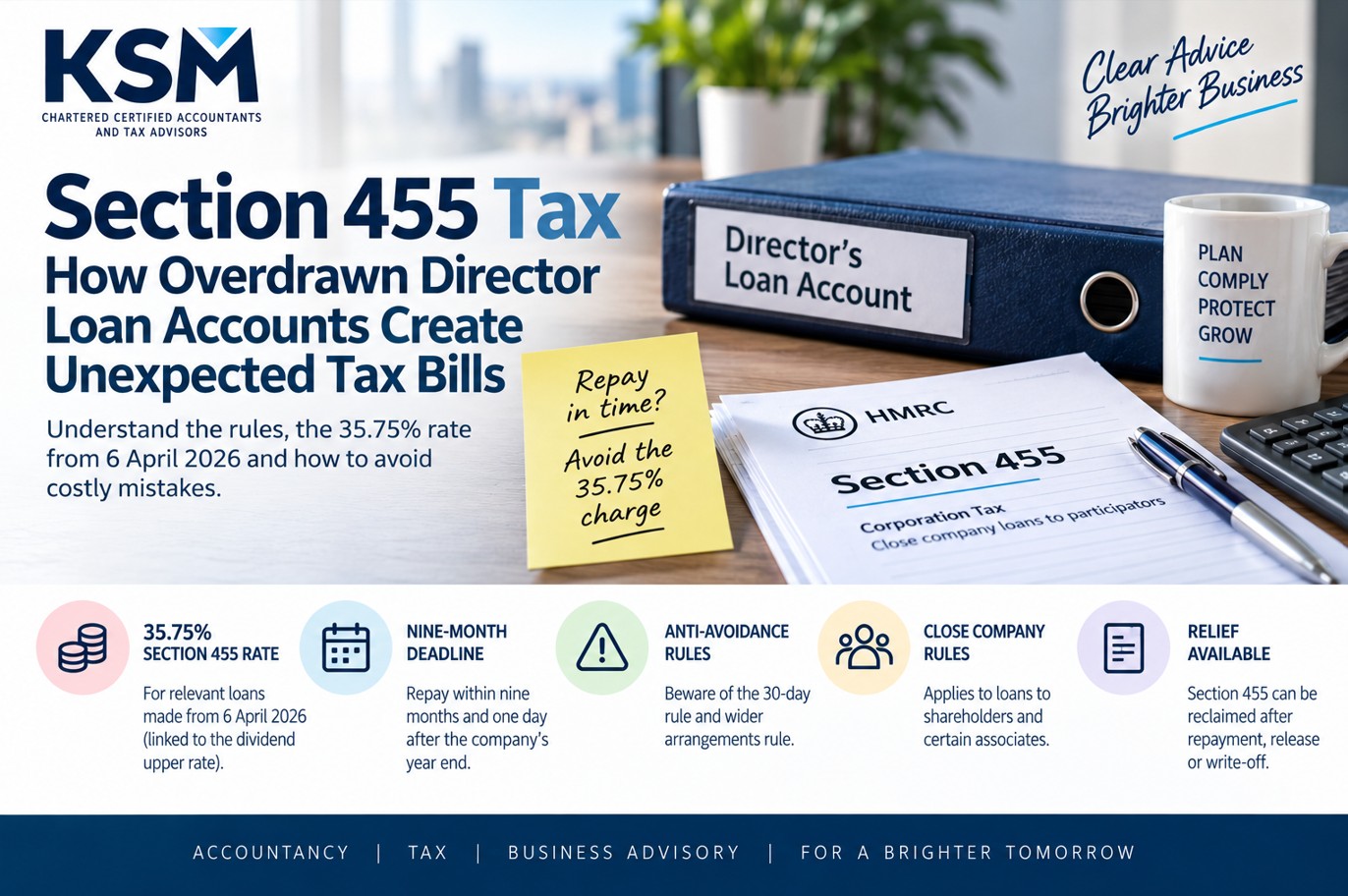
For many owner-managed companies, this is where section 455 tax becomes an expensive surprise. The director may regard the withdrawal as temporary, the bookkeeping may simply show an overdrawn director’s loan account, and there may be enough cash in the company to fund it.
However, where a close company lends money to a shareholder or other participator and the balance remains outstanding beyond the statutory period, the company can face a separate tax charge under section 455 Corporation Tax Act 2010.
For relevant loans made on or after 6 April 2026, the section 455 rate is 35.75%. HMRC confirms that the rate is linked to the dividend upper rate and increased from 33.75% to 35.75% from that date.
A £50,000 outstanding loan can therefore generate a £17,875 tax payment by the company, even though the £50,000 itself is still owed by the director.
That is why section 455 should not be treated as an obscure year-end adjustment. It is a cash-flow issue that shareholder-directors should understand before money is withdrawn.
Why this matters
The section 455 regime is aimed primarily at close companies.
Most UK owner-managed private companies fall within the close company rules because control is concentrated in a relatively small number of shareholders.
The legislation applies where a close company makes a loan or advances money to a participator, or to certain associates of a participator. A shareholder will normally be a participator for these purposes. Section 455 CTA 2010 imposes a company-level tax charge on qualifying loans.
The practical problem is that an overdrawn director’s loan account can arise without the director consciously deciding to take a formal loan.
For example, the company may:
- pay a director’s personal credit card;
- pay private household expenses;
- transfer cash to the director;
- pay private travel costs;
- fund personal property expenditure;
- allow the director to draw money in anticipation of a future dividend.
If those amounts cannot properly be treated as salary, dividend, repayment of expenses or repayment of money already owed by the company, they may be posted to the director’s loan account.
HMRC defines a director’s loan as money taken from the company that is not salary, dividend, expense reimbursement or repayment of money previously paid into or lent to the company. Companies are required to keep records of these movements through the director’s loan account.
How the section 455 rules work
The starting point is straightforward.
Where a close company makes a qualifying loan to a participator during an accounting period and that loan is not repaid within the relevant period, the company may have to pay section 455 tax.
The statutory payment date is nine months and one day after the end of the accounting period in which the loan was made. HMRC expressly confirms this due date in its Company Taxation Manual.
This means the company accounting period is critical.
It is not the same as the director’s personal tax year.
For example, if a company has a 31 March 2027 year end, section 455 tax on a qualifying loan made during that accounting period would generally become due on 1 January 2028, unless the loan has been effectively repaid, released or written off in accordance with the rules before the relevant point.
The liability must be reported through the company’s Corporation Tax compliance. HMRC requires qualifying loans and section 455 liabilities to be reported on the supplementary CT600A pages.
The 35.75% rate from 6 April 2026
The rate of section 455 tax depends on when the loan is made.
HMRC states that:
- loans made from 6 April 2022 were subject to a 33.75% rate; and
- loans made from 6 April 2026 are subject to 35.75%.
This increase matters materially for larger director loan balances.
For every £100,000 of qualifying loan subject to the current rate, the potential section 455 liability is:
£100,000 × 35.75% = £35,750
The company therefore loses £35,750 of cash to HMRC until relief becomes available.
This is one reason why section 455 should be considered as part of cash-flow planning rather than merely as a Corporation Tax disclosure.
Practical Example
Assume Alpha Trading Ltd is an owner-managed company with a 31 March 2027 year end.
Its sole shareholder-director withdraws £80,000 from the company during the accounting period.
The amount is not:
- salary;
- a valid dividend;
- reimbursement of a business expense; or
- repayment of money previously lent by the director to the company.
It is therefore recorded as an overdrawn director’s loan account.
At 31 March 2027, the full £80,000 remains outstanding.
The director does not repay it within nine months of the year end.
The potential section 455 tax is therefore:
£80,000 × 35.75% = £28,600
The company must potentially pay £28,600 to HMRC.
However, two important points follow.
First, the £80,000 is still owed by the director to the company.
Second, the £28,600 section 455 payment is not a permanent substitute for the loan.
The company therefore has an £80,000 debtor on its balance sheet and has also suffered a substantial temporary tax cash outflow.
If the director later repays the £80,000, the company may eventually claim relief for the section 455 tax, subject to the statutory rules.
Section 455 is not ordinary Corporation Tax
Section 455 is sometimes described loosely as Corporation Tax on the director’s loan.
That description can be misleading.
The charge is collected as if it were Corporation Tax, but it is not a tax on the company’s trading profit.
It is a separate charge under the close company rules.
This distinction is commercially important because paying section 455 does not:
- extinguish the director’s debt;
- turn the loan into a dividend;
- remove a benefit-in-kind liability;
- create a deductible business expense equivalent to the loan; or
- permanently settle the director’s personal position.
The loan remains legally repayable unless it is subsequently repaid, released, written off or otherwise validly dealt with.
Can section 455 tax be reclaimed?
Yes, subject to the statutory conditions.
Section 458 CTA 2010 provides relief where the loan is subsequently repaid, released or written off. The legislation provides for proportionate relief where only part of the balance is dealt with.
However, directors often overlook the delay before repayment of the section 455 tax is available.
HMRC states that where repayment, release or write-off occurs after the section 455 tax has become due, relief is generally not available until nine months and one day after the end of the accounting period in which the repayment, release or write-off occurred.
The company may therefore remain out of pocket for a considerable period.
HMRC also states that any interest paid on the original section 455 liability is not reclaimable merely because the loan is later repaid.
The statutory claim normally has to be made within four years of the end of the financial year in which the repayment, release or write-off takes place.
This makes correct tracking essential.
The 30-day anti-avoidance rule
A common reaction to an approaching section 455 deadline is:
“I will repay the loan before the deadline and take the money back afterwards.”
The tax rules specifically address this.
The so-called bed-and-breakfasting rule can apply where repayments of at least £5,000 are made and new loans of at least £5,000 arise within a 30-day period.
HMRC explains that the repayment may be matched against the new borrowing rather than against the earlier loan. This can prevent section 455 relief being obtained through what is effectively only a temporary repayment.
Example
A director owes the company £40,000.
On 20 December, the director repays £40,000.
On 5 January, the company advances £40,000 back to the director.
Because the repayment and new borrowing occur within the relevant 30-day window, the legislation may effectively treat the repayment as matched against the new loan rather than permanently clearing the original balance.
The result can be that section 455 remains payable on the earlier loan.
The commercial substance therefore matters.
Moving cash into the company temporarily does not necessarily solve the tax problem.
The wider arrangements rule
There is also a second anti-avoidance provision.
HMRC confirms that where at least £15,000 is outstanding immediately before repayment and, at that time, arrangements exist under which at least £5,000 will subsequently be lent or advanced again, the repayment can be matched against that subsequent borrowing.
This rule can apply even outside the 30-day period.
It is therefore not sufficient simply to wait 31 days if there was already an understanding or arrangement that the money would be reborrowed.
The anti-avoidance rules need to be considered according to the facts.
Paying the loan off with a dividend
A shareholder-director may sometimes be able to clear an overdrawn director’s loan account by declaring a dividend and crediting it to the loan account.
This can be legitimate, but only where the company has sufficient distributable profits and the dividend is validly declared.
A company cannot simply create a dividend retrospectively because a director’s loan needs to be cleared.
The dividend must also be taxed personally on the shareholder.
For 2026/27, the dividend ordinary rate is 10.75%, the upper rate is 35.75% and the additional rate remains 39.35%, subject to the shareholder’s available dividend allowance and wider tax position.
The correct decision therefore requires comparison of:
- available distributable reserves;
- the shareholder’s Income Tax position;
- the section 455 exposure;
- company cash flow; and
- whether the dividend is commercially and legally appropriate.
What if the loan is written off?
A company may decide not to require repayment and instead release or write off the director’s loan.
That does not make the transaction tax-free.
The company may obtain relief from section 455 under section 458, but the write-off can create separate tax consequences for the individual and potentially National Insurance consequences depending on the circumstances.
HMRC’s current director loan guidance confirms that where a loan is written off or released, the director may have an Income Tax liability and the company may have payroll-related National Insurance responsibilities.
A write-off should therefore be treated as a substantive transaction rather than a bookkeeping adjustment.
Section 455 and beneficial loan tax are separate
An overdrawn director’s loan can also produce a benefit-in-kind charge where the relevant conditions are met.
This is separate from section 455.
For example, a director may face a taxable beneficial loan because the company has provided an interest-free or low-interest loan exceeding the relevant exemption, while the company separately incurs section 455 because the loan remains outstanding.
One charge does not replace the other.
The company and personal tax consequences therefore need to be reviewed independently.
This is particularly important for directors who assume that paying section 455 means the personal tax position has also been dealt with.
It has not necessarily been.
Common pitfalls
1. Assuming the nine-month rule means the loan is tax-free
Repayment within nine months may prevent the section 455 payment becoming due, but anti-avoidance provisions, beneficial loan rules and reporting requirements can still need consideration.
2. Ignoring the date the loan was originally advanced
For loans made from 6 April 2026, the section 455 rate is 35.75%. Older loans may have arisen under different rates.
3. Temporarily repaying before the deadline
Repayment followed by new borrowing can be caught by the 30-day rule or wider arrangements rule.
4. Assuming cash in the bank means a dividend can be declared
Dividends depend on distributable profits, not merely cash availability.
5. Forgetting to reclaim section 455 later
A company that eventually receives repayment may be entitled to relief, but the relief has to be claimed and is subject to time limits.
6. Reviewing the DLA only when annual accounts are prepared
By that point the company may already be close to its section 455 payment date, leaving fewer practical planning options.
Tax planning and commercial opportunities
The objective should not be to find an artificial way around section 455.
The better approach is to determine why the director’s loan exists and how it fits into the wider remuneration and financing strategy.
Possible legitimate options may include:
- genuine repayment from personal resources;
- declaring a lawful dividend where adequate reserves exist;
- paying properly processed salary or bonus;
- offsetting a genuine credit balance owed elsewhere to the director;
- charging and paying appropriate interest where beneficial loan rules are relevant;
- deliberately retaining the loan and accepting the section 455 cost where this is commercially justified.
Each route has different tax consequences.
For example, clearing a £50,000 loan using a dividend may remove the outstanding loan but create personal dividend tax.
Clearing it using salary may generate PAYE and National Insurance.
Paying section 455 may preserve personal liquidity but tie up substantial company cash.
There is therefore no universal answer.
Risks and HMRC considerations
HMRC can enquire into section 455 as part of a Corporation Tax enquiry.
HMRC’s manual confirms that section 455 liabilities are subject to the Corporation Tax self-assessment regime, including interest and relevant penalty provisions.
HMRC’s Enquiry Manual also makes clear that where omitted or incorrectly treated director loan extractions are identified during an enquiry, section 455, interest and potentially penalties can form part of the settlement.
Accurate records should therefore show:
- the date of each loan or advance;
- the balance outstanding at each accounting period end;
- repayments made;
- further borrowing;
- any dividends credited;
- salary or bonuses credited;
- interest charged;
- amounts written off or released;
- the section 455 calculation; and
- any later claim for relief.
Since April 2026, HMRC has also provided an online process through which companies, officers, participators or authorised agents may be asked to confirm that participator loans previously declared on the Corporation Tax return have been repaid in full.
This reinforces the importance of maintaining contemporaneous evidence of repayment.
Action points for business owners
Before the company’s year end and again before the section 455 payment date, shareholder-directors should:
- obtain an up-to-date director’s loan account;
- identify all personal transactions paid by the company;
- establish when each material loan arose;
- calculate the potential section 455 exposure at the correct rate;
- determine whether the loan will genuinely be repaid within nine months of the accounting period end;
- check for any reborrowing that could trigger the 30-day or arrangements rules;
- review distributable reserves before considering dividends;
- consider any separate beneficial loan exposure;
- ensure CT600A reporting is correct; and
- diarise any later section 458 repayment claim.
The review should be completed before transactions are implemented, not reconstructed after the deadline.
KSM perspective
Section 455 is best viewed as a cash-flow penalty for allowing shareholders prolonged access to company funds through loans rather than conventional remuneration or distributions.
At 35.75% for relevant loans made from 6 April 2026, the cash cost is now substantial.
A £100,000 overdrawn director’s loan account can potentially require £35,750 to be paid to HMRC while the director still owes the full £100,000 to the company.
That makes director loan monitoring a management issue as much as a tax compliance issue.
The practical solution is regular review.
Shareholder-directors should know their loan account balance during the year, understand the tax cost before taking significant personal withdrawals and decide deliberately whether the balance will be repaid, cleared through remuneration or dividends, or left outstanding with the associated tax consequences.
Discovering a large section 455 liability when the year-end accounts are finally prepared is usually evidence that the issue has been considered too late.
Tax and accounting treatment will depend on the particular circumstances of the company and its shareholders or directors. This article provides general information only and should not be treated as personalised tax, accounting or legal advice. Professional advice should be obtained before implementing any transaction or planning strategy.



This article is general guidance only and does not constitute tailored tax advice. Please contact KSM Consulting Ltd for advice based on your circumstances.