
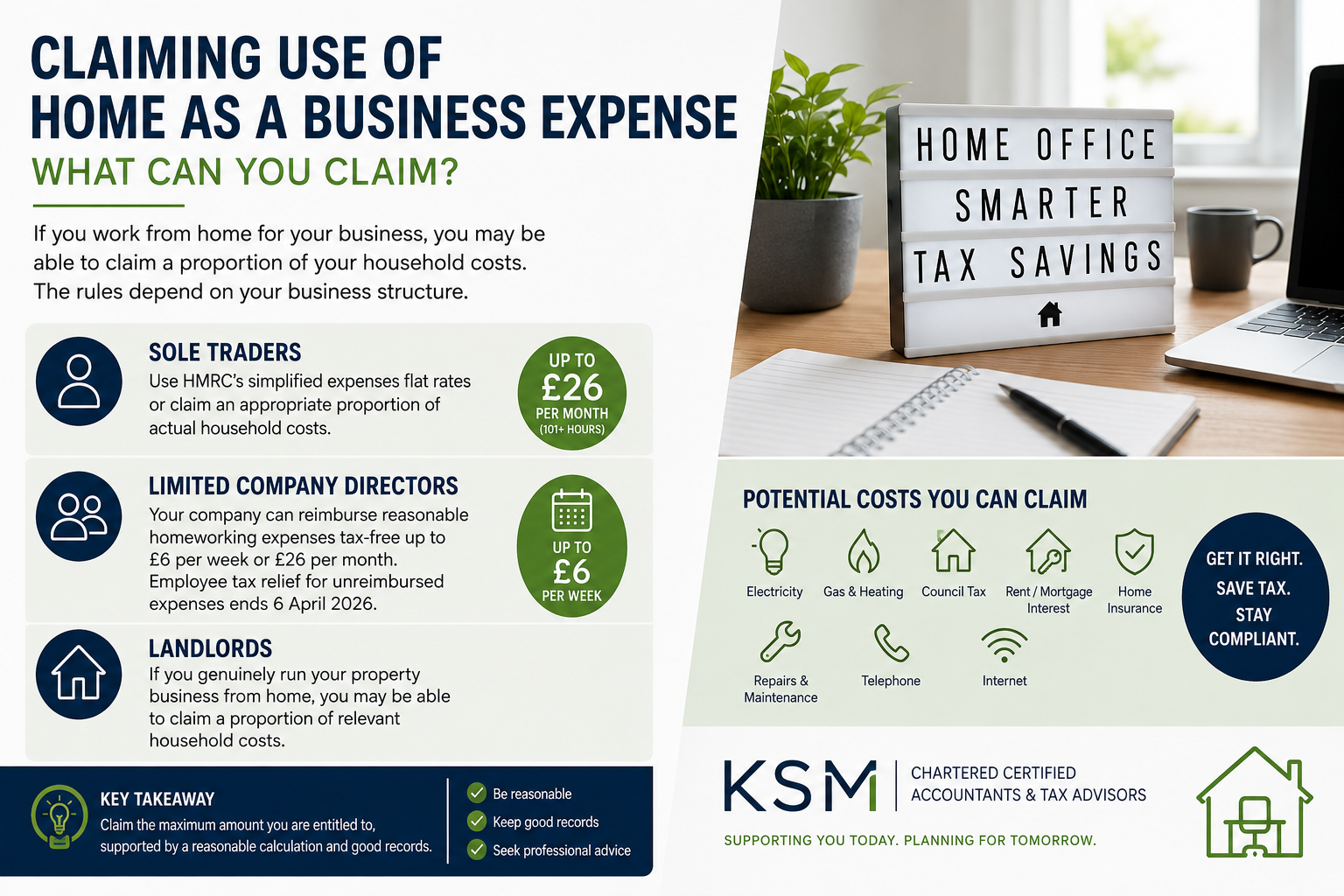
 Working from home has become a normal part of running a business. Whether you are a sole trader working from a spare bedroom, a landlord managing properties from home, or a director occasionally working from your home office, you may wonder: How can I claim home business expenses? You can easily claim home business expenses with the right understanding of the rules.
Understanding the use of home can greatly benefit your financial management.
Can I claim some of my household costs as a business expense?
Many self-employed individuals may wonder about the use of home costs as deductible expenses.
The answer is often yes, but the amount you can claim and the method you should use depend on how your business is structured and how your home is actually used.
Make sure you are aware of the implications of the use of home for tax purposes.
Getting this right matters. Claim too little and you may pay more tax than necessary. Claim too much, or use the wrong method, and HMRC may challenge the deduction.
It is crucial to accurately track the use of home for your business to maximise deductions.
It’s important to understand how to claim home business expenses effectively to maximise your tax relief.
The use of home can include various expenses based on how your home is utilized for business.
What does “use of home as office” mean?
If you genuinely carry out business activities from your home, some of the costs associated with that business use may potentially be deductible.
The rules surrounding the use of home may differ significantly between different business structures.
For example, you might:
Business owners should consider the use of home when calculating their expenses.
-
- prepare quotations and invoices;
- maintain your accounting records;
Understanding the use of home expenses is vital for effective tax planning.
-
- claim home business expenses for your workspace;
- answer business emails and telephone calls;
The potential deductions related to the use of home can save you money in the long run.
-
- hold online meetings;
- evaluate what you can claim home business expenses for;
Evaluating the use of home is a necessary step for any self-employed individual.
-
- undertake administrative work;
- market your business;
Each business should determine the appropriate use of home to ensure compliance with tax regulations.
-
- manage employees or subcontractors; or
- carry out the actual work of the business from home.
Being mindful of the use of home for business can lead to better financial outcomes.
Simply checking the occasional email at home does not necessarily justify allocating a substantial proportion of your household costs to the business.
To accurately claim home business expenses, consider documenting all relevant transactions and maintaining clear records.
Documenting the use of home can help defend your claims should HMRC challenge your deductions.
The tax treatment also depends on whether you are self-employed, operating through a limited company, or running a property business.
1. Sole traders and self-employed individuals
For sole traders, understanding the use of home is essential to navigate tax liabilities.
How to Claim Home Business Expenses Effectively
For a sole trader, HMRC broadly allows two approaches:
The use of home is often a grey area; clarity is key to successful claims.
Option 1: simplified expenses, using HMRC’s flat rates; or
Knowing how to claim home business expenses can simplify your tax return.
Knowing how to maximise the use of home can enhance your tax efficiency.
Option 2: calculating the actual business proportion of household costs.
The better method will depend on your circumstances.
Consider the actual use of home before claiming any deductions for household costs.
Simplified expenses
HMRC’s simplified expenses regime allows eligible sole traders and qualifying partnerships to claim a monthly flat rate based on the number of hours they work from home.
The calculations around the use of home should reflect real business activities.
The current rates are:
Understanding how to claim home business expenses can prevent costly mistakes.
Make sure to incorporate the use of home into your yearly tax planning.
- maximize your claim home business expenses potential;
The use of home is an integral part of managing your business expenses.Reviewing the use of home helps clarify what can be claimed.Home-based businesses benefit significantly from understanding the use of home in expense claims.Considering the use of home can lead to maximising allowable deductions.
| Business use of home per month | Flat-rate expense |
|---|---|
| 25 to 50 hours | £10 per month |
| 51 to 100 hours | £18 per month |
| 101 hours or more | £26 per month |
You need to work from home for at least 25 hours in a month before the flat-rate homeworking deduction applies.
Before claiming, think about how the use of home impacts your overall tax position.
When you know how to claim home business expenses properly, you can avoid tax challenges.
For example, if you regularly carry out business activities from home for more than 101 hours each month throughout the year, the simplified claim would normally be:
Tracking the use of home diligently can safeguard your claims with HMRC.
£26 × 12 = £312 per year
The attraction of this method is simplicity. You do not have to undertake a detailed calculation of the business proportion of household running costs.
Exploring the use of home deeply can yield significant tax benefits.
However, simplified expenses are not necessarily the most tax-efficient option.
Telephone and internet costs are also not included within this homeworking flat rate. An appropriate business proportion of those costs can potentially be calculated separately.
Understanding the implications of the use of home can protect your interests.
2. Claiming actual household costs
It’s essential to know how to claim home business expenses correctly to maximize your tax benefits.
For landlords, the use of home is often vital in justifying expense claims.
Instead of using simplified expenses, a self-employed person can consider claiming an appropriate proportion of their actual household expenses.
Depending on the circumstances, relevant costs can potentially include items such as:
Clarifying the use of home helps both landlords and sole traders maximise their claims.
-
- electricity;
- gas and heating;
Directors must be aware of the use of home when claiming related expenses.
-
- Council Tax;
- rent;
Understanding the use of home aids in navigating complex tax regulations.
-
- mortgage interest;
- home insurance;
Being informed about the use of home can simplify your tax situation significantly.
-
- repairs and maintenance;
- telephone costs; and
The intricate details of the use of home can make a substantial difference in claims.
-
- document your methods to claim home business expenses;
- internet costs.
Assessing your use of home is crucial for optimising deductions.
This does not mean that someone working from their spare bedroom can simply put 20% or 25% of all their household bills through the business.
There must be a reasonable method of allocating expenditure between private and business use.
Keep in mind that the proper use of home can lead to better financial decisions.
How might the business proportion be calculated?
There is no single calculation that will be appropriate in every case.
Directors should always consider the use of home when evaluating their tax position.
A reasonable calculation may consider:
-
-
- the number of rooms in the property;
By understanding the use of home, you can ensure compliance with tax laws and regulations.
-
- which rooms are used for business;
- the amount of time those rooms are used for business; and
Remember that the use of home is a vital element in any business expense discussion.
- the nature of each particular expense.
-
To ensure you can claim home business expenses without issues, keep detailed logs.
The effective use of home can lead to smarter tax strategies for your business.
Consider a simplified example.
Sarah is a self-employed consultant. Her home has five principal rooms and she uses one bedroom as an office.
Assess your use of home regularly to make informed decisions about your claims.
The office is used for business for approximately eight hours each weekday, but the room also has private use outside working hours.
It would therefore normally be inappropriate simply to claim one-fifth of every household expense.
Proper documentation of your use of home can help you substantiate claims made to HMRC.
A more reasonable calculation could first identify the proportion relating to the relevant room and then adjust that amount to reflect the extent of business use.
The correct calculation depends on the facts and should be capable of being explained if HMRC asks how the deduction was determined.
Ultimately, understanding the use of home is essential for successful tax planning.
3. Simplified expenses or actual costs: which is better?
This is where a little calculation can make a meaningful difference.
The use of home is an often-overlooked aspect of tax preparation that can yield significant benefits.
Suppose a sole trader works from home for more than 101 hours every month.
The simplified expense would be:
Directors should also evaluate the potential use of home deductions when filing taxes.
£26 × 12 = £312
But suppose a reasonable calculation of the actual business proportion of electricity, heating, Council Tax, insurance and other qualifying household costs produces an allowable amount of £1,200.
Keeping track of the use of home can simplify the tax filing process considerably.
In that situation, subject to the underlying calculation being appropriate, claiming actual costs could provide a substantially larger deduction.
When deciding on how to claim home business expenses, evaluate both methods.
Consider how the use of home impacts your overall tax strategy for maximum benefit.
The simplified method is therefore not automatically the best method merely because it is easier.
For clients who make significant use of their home for business, it can be worthwhile comparing both calculations.
Carefully evaluating your use of home can reveal opportunities for savings.
4. What about limited company directors?
This is an important distinction.
Understanding the use of home expenses is a cornerstone of effective tax management.
The simplified expenses rules described above are available to sole traders and certain partnerships. They cannot be used by a limited company.
A director cannot simply apply the sole trader £10, £18 or £26 monthly rates to the company’s accounts.
The intricate relationship between business and personal use of home can affect your financial outcomes.
Instead, different employment tax rules apply.
Directors should be informed on how to claim home business expenses appropriately.
Ultimately, knowledge of the use of home can make a lasting impact on your business’s bottom line.
Where appropriate homeworking arrangements exist, a company can potentially reimburse an employee or director for reasonable additional household expenses arising from working at home.
HMRC currently allows an employer to pay up to:
Don’t underestimate the role of the use of home in shaping your tax obligations.
£6 per week, or £26 per month
without having to justify the amount of additional expenditure, provided the relevant conditions for the homeworking exemption are satisfied.
By focusing on the use of home, you can ensure that your claims align with tax regulations.
If more than this amount is reimbursed tax-free, evidence will generally be required to demonstrate that the additional household costs justify the higher payment.
This is different from the self-employed simplified expense regime, even though £26 per month happens to appear in both sets of rules.
Engaging with the concept of the use of home can lead to improved tax compliance.
An important change from 6 April 2026
The rules for employees changed from the beginning of the 2026/27 tax year.
Exploring the use of home will provide insights into your business’s tax position.
This change impacts how you can claim home business expenses in future tax returns.
From 6 April 2026, employees can no longer claim an Income Tax deduction directly from HMRC for their own unreimbursed additional household expenses incurred while working from home.
Awareness of the use of home can help you navigate complex tax landscapes.
However, this does not abolish the separate exemption allowing employers to reimburse qualifying homeworking expenses.
Therefore, where a director regularly works from home, it is worth considering the position at company level rather than assuming the director can personally claim homeworking tax relief from HMRC.
The concept of the use of home is critical for effective expense management.
Directors need to understand how to claim home business expenses to optimize their tax situation.
5. Can a director charge rent to their own company?
Companies should carefully assess the use of home when planning their expenses.
Potentially, yes, but this requires considerably more care.
Where a company makes genuine business use of part of a director’s home, it may be possible to put a formal arrangement in place under which the company pays the director for that use.
Understanding the use of home can prevent costly tax mistakes.
However, this is not simply a way of extracting money from the company tax-free.
The arrangement can create tax consequences for the homeowner personally and may also raise issues concerning:
Directors need to maintain clarity about the use of home in their financial reporting.
-
-
- property income;
- allowable household expenditure;
Decisions regarding the use of home can significantly affect tax liabilities.
-
- Capital Gains Tax;
- mortgage conditions;
Clarity on the use of home serves as a foundation for all tax-related decisions.
-
- insurance;
- business rates in some circumstances; and
Being proactive about the use of home can lead to substantial financial advantages.
- the terms of any lease or tenancy agreement.
-
Understanding how to claim home business expenses can help directors stay compliant.
A thorough understanding of the use of home can facilitate smoother tax processes.
Professional advice should therefore be taken before introducing a formal rental arrangement between a director and their company.
6. What about landlords working from home?
Businesses that leverage the use of home appropriately will thrive.
A landlord who genuinely operates their property business from home may also be able to deduct appropriate homeworking costs.
Landlords also benefit from knowing how to claim home business expenses effectively.
In conclusion, the use of home is a pivotal element of tax strategy for any business.
HMRC accepts that where a property business is genuinely run from home, additional business costs such as extra lighting and heating may be deductible.
Where a particular part of the home is used substantially for managing the property business, an appropriate proportion of certain fixed household costs may also potentially be deductible.
Identifying how to claim home business expenses can simplify tax reporting for landlords.
Again, the expenditure must be connected with the property business and the calculation should be reasonable.
Be careful with exclusive business use
One issue that is sometimes overlooked is Capital Gains Tax.
Landlords should know exactly how to claim home business expenses to optimize tax efficiency.
Private Residence Relief can normally protect some or all of the gain arising when an individual’s main home is sold.
However, where part of a home has been used exclusively for business purposes, that exclusive business use can potentially restrict Private Residence Relief in relation to that part of the property.
This is one reason why describing a room as being used “100% exclusively for business” should not be done casually simply to maximise an expense claim.
A home office that also has genuine private use may produce a different CGT position from an area set aside exclusively for business.
What records should you keep?
A use-of-home claim should be based on something more substantial than an arbitrary figure entered into the accounts at the end of the year.
Depending on the method used, useful records can include:
It’s crucial to know how to claim home business expenses for accurate tax calculations.
- electricity and gas bills;
- Council Tax statements;
- rent statements;
- mortgage interest information;
- insurance documents;
- telephone and broadband bills;
- details of the number of rooms in the property;
- details of which areas are used for business;
- approximate working hours; and
- a written calculation showing how the business proportion was determined.
You should be able to explain how the figure was calculated if HMRC subsequently asks.
Common mistakes when claiming use of home expenses
Some of the most common problems we see are:
Claiming an arbitrary percentage of all household bills
A percentage should have a reasonable basis and reflect both the nature and extent of business use.
Using the self-employed flat rate for a limited company
Simplified expenses are not available to limited companies.
Assuming the £6 per week employee rule is the same as the sole trader simplified expense
They are separate provisions with different rules and conditions.
Claiming the entire broadband or telephone bill
Where there is both business and private use, an appropriate allocation may be required.
Ignoring private use of the room
Claiming home business expenses requires careful consideration to avoid mistakes.
Using one room for work does not automatically mean that the entire cost attributable to that room is deductible.
Claiming exclusive business use without considering CGT
A larger expense claim today can potentially have consequences when the property is eventually sold.
How much tax can a use-of-home claim actually save?
Understanding how to claim home business expenses can have significant tax benefits.
An allowable business expense reduces taxable profit rather than normally generating a pound-for-pound tax refund.
For example, suppose a sole trader has:
Profit before use-of-home expenses: £60,000
and a properly calculated use-of-home deduction of:
£1,200
Taxable trading profit would, subject to the wider tax computation, reduce to:
£58,800
The actual tax saving depends on the individual’s tax position, including their marginal Income Tax rate and National Insurance position.
The same principle applies to companies. An allowable expense reduces taxable company profits and can therefore reduce Corporation Tax, subject to the normal tax rules.
So, how much should you claim?
There is no universal answer.
For a self-employed person with relatively modest homeworking, HMRC’s simplified expense may provide an easy and proportionate solution.
For someone running a substantial part of their business from home, calculating the actual business proportion of household expenditure could potentially produce a larger allowable deduction.
For company directors, the rules are different again and consideration should be given to qualifying employer reimbursements and, in appropriate cases, whether a more formal arrangement is justified.
The objective should not simply be to claim the largest number possible.
It should be to claim the maximum amount legitimately available under the tax rules, supported by a reasonable calculation and appropriate evidence.
Need help calculating your use-of-home expenses?
At KSM Chartered Certified Accountants and Tax Advisors, we help sole traders, landlords, company directors and owner-managed businesses identify legitimate business expenses and structure their tax affairs efficiently.
If you regularly work from home and are unsure about how to claim home business expenses correctly, we can review your circumstances, compare the available methods, and determine an appropriate claim.
Contact KSM Chartered Certified Accountants and Tax Advisors to discuss your business expenses and tax position.
This article is intended as general information and does not constitute individual tax advice. Tax treatment depends on the particular facts and circumstances, and tax rules can change.
This article is intended as general information on how to claim home business expenses and does not constitute individual tax advice. Tax treatment depends on the particular facts and circumstances, and tax rules can change.
This article is general guidance only and does not constitute tailored tax advice. Please contact KSM Consulting Ltd for advice based on your circumstances.