
Allowable Business Expenses: What Can You Claim Under HMRC’s “Wholly and Exclusively” Rule?
Claiming business expenses is one of the most common areas where business owners, landlords and self-employed individuals become uncertain. Many people look for a fixed HMRC list of allowable expenses, but in reality, there is no single complete list that covers every business, every sector and every situation.
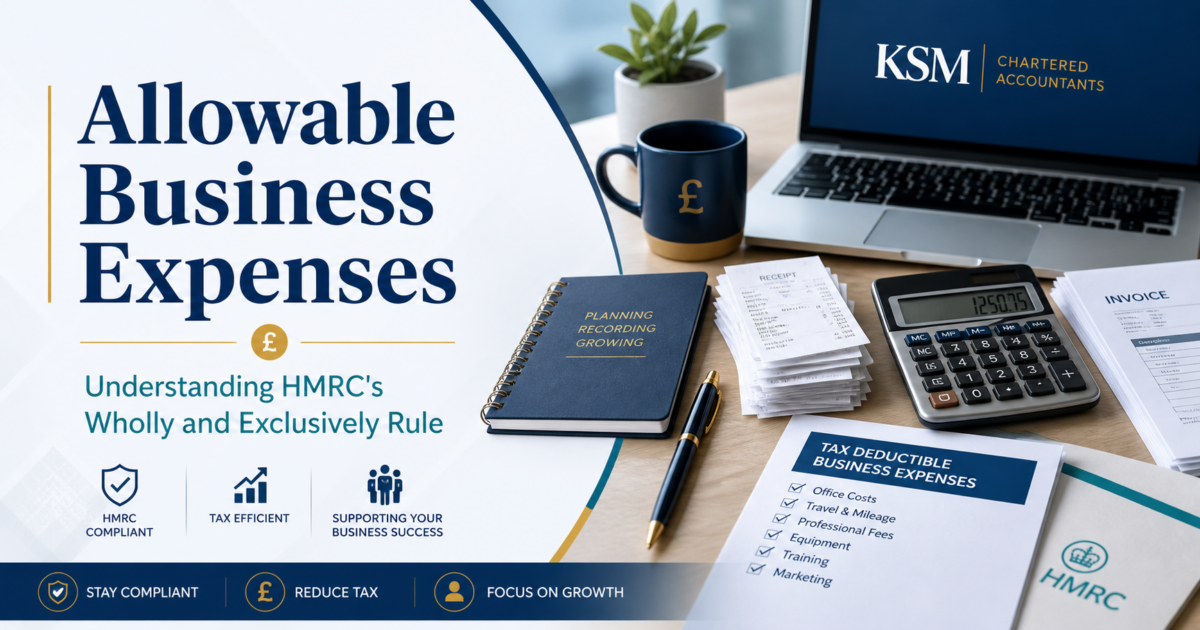
Instead, HMRC applies a core principle: an expense must be incurred wholly and exclusively for the purposes of the business. This rule applies to trading businesses, companies, sole traders and, in many cases, property businesses. HMRC’s own Business Income Manual confirms that expenditure is restricted where it is not incurred wholly and exclusively for the purposes of the trade, profession or vocation.
This means the tax treatment often depends on the purpose of the expense, the evidence available, and whether any private or personal benefit is involved.
What Does “Wholly and Exclusively” Mean?
The phrase “wholly and exclusively” means that the expense must be incurred for business purposes only. The key question is:
Was the expense incurred for the purpose of earning business income or running the business?
If the answer is yes, the cost may be allowable. If the expense has a personal purpose, family purpose or private benefit, HMRC may disallow it either fully or partly.
For example, if a business pays for accountancy fees, software subscriptions, office costs or advertising, these are normally business expenses because they are directly connected to running the business.
However, if a business owner buys ordinary clothing, family travel, personal meals or household items and tries to put them through the business, HMRC may challenge the claim.
There Is No Complete HMRC List of Allowable Expenses
HMRC provides examples of common allowable expenses, but these examples should not be treated as a full and final list. GOV.UK guidance for self-employed expenses explains that costs can include office costs, travel costs, staff costs, stock, financial costs, marketing and other business-related expenses. It also makes clear that where something is used for both business and personal reasons, only the business part can be claimed.
For companies, HMRC’s Corporation Tax guidance similarly explains that companies can deduct some running costs when calculating taxable profits, provided the costs are revenue expenses and included in the company accounts.
This is why the correct approach is not simply asking: “Is this item on HMRC’s list?”
The better question is:
Can we prove that this expense was incurred for the business and not for personal reasons?
Common Allowable Business Expenses
Although every business is different, the following types of costs are commonly allowable where they are genuinely business-related.
1. Office and Administration Costs
These may include:
- office rent
- stationery
- printing
- postage
- telephone costs
- internet costs
- business software
- cloud storage
- accounting software
- office equipment
If the cost is used partly for private purposes, only the business proportion should be claimed.
2. Accountancy and Professional Fees
Fees paid to accountants, tax advisers, bookkeepers, solicitors and consultants are usually allowable where they relate to the business.
Examples include:
- annual accounts
- Corporation Tax returns
- Self Assessment tax returns for business income
- VAT returns
- payroll services
- tax enquiry support
- business legal advice
However, professional fees relating to personal matters, capital transactions or non-business issues may need separate tax treatment.
3. Travel and Motor Expenses
Business travel can be allowable where the journey is made for business purposes. This may include:
- visiting clients
- attending business meetings
- travelling to temporary workplaces
- business mileage
- train, taxi or bus fares
- parking costs
- business-related hotel stays
However, ordinary commuting between home and a normal workplace is generally not allowable. Travel with a mixed personal and business purpose should be reviewed carefully.
4. Marketing and Advertising
Marketing costs are usually allowable because they are incurred to attract customers and grow the business.
Examples include:
- website design and maintenance
- SEO services
- Google Ads
- social media advertising
- flyers and brochures
- branding
- photography for business use
- business cards
- email marketing tools
For businesses trying to grow online, a well-documented marketing budget can be an important allowable cost.
5. Staff Costs
Staff costs are generally allowable where the employee is genuinely working for the business and the payment is commercially reasonable.
Examples include:
- wages and salaries
- employer National Insurance
- employer pension contributions
- staff training
- recruitment costs
- staff uniforms, where required for the job
Where family members are on the payroll, extra care is needed. HMRC may ask whether the person genuinely worked for the business, whether the pay was reasonable, and whether the arrangement was commercial.
6. Training and Development
Training costs can be allowable where they are connected to the business or the employee’s role.
This may include:
- technical training
- professional development
- leadership training
- software training
- compliance training
- industry-specific courses
The stronger the link between the training and the business, the safer the claim. If the training is mainly personal, recreational or unrelated to the business, it may be challenged.
7. Use of Home as Office
Many directors, landlords and self-employed individuals do some business work from home. A reasonable business proportion of home costs may be claimed, depending on the structure and facts.
This could include a proportion of:
- electricity
- gas
- internet
- phone
- council tax, in some cases
- rent or mortgage interest, depending on the circumstances
- home insurance
Alternatively, simplified or fixed-rate methods may be available in certain situations.
The key point is that the claim should be reasonable and supported by a calculation.
8. Business Insurance
Business-related insurance is normally allowable. Examples include:
- professional indemnity insurance
- public liability insurance
- employer’s liability insurance
- office insurance
- business vehicle insurance
- cyber insurance
- landlord insurance for rental businesses
Personal insurance is not normally allowable unless there is a specific business reason and the correct tax treatment is applied.
9. Subscriptions and Memberships
Professional subscriptions may be allowable if they are relevant to the business or employment.
Examples include:
- professional body memberships
- trade association memberships
- business networking memberships
- industry publications
- specialist technical resources
The subscription should have a clear business purpose.
10. Repairs and Maintenance
Repairs to business assets are usually allowable as revenue expenses, provided they restore the asset rather than improve it.
Examples include:
- repairing office equipment
- repairing business premises
- maintaining rental property
- servicing business vehicles
- fixing business machinery
However, improvements, upgrades or new assets may be capital expenditure rather than normal business expenses.
Mixed-Use Expenses: Business and Personal Use
Some expenses have both business and personal use. HMRC allows the business element to be claimed where it can be reasonably identified. GOV.UK gives the example of a mobile phone bill where only the business-call element is claimed.
Common mixed-use expenses include:
- mobile phones
- internet
- motor vehicles
- home office costs
- travel
- training
- laptops and computers
For these costs, business owners should make a fair and consistent adjustment.
For example, if 60% of mobile phone use is for business and 40% is personal, only 60% should normally be claimed.
Incidental Personal Benefit Does Not Always Disallow the Expense
A useful point in HMRC’s guidance is that an incidental personal benefit does not automatically make an expense disallowable. HMRC’s manual explains that where an expense is incurred wholly and exclusively for the business, an incidental benefit does not by itself prevent the deduction.
For example, a business owner may enjoy attending a professional conference, but if the reason for attending is business development, technical learning or networking, the cost may still be allowable.
The problem arises where the personal purpose is not merely incidental but is one of the main reasons for the expenditure.
Expenses HMRC May Challenge
HMRC may challenge expenses such as:
- family travel
- personal meals
- ordinary clothing
- private school fees
- non-business training
- excessive entertainment
- personal holidays described as business trips
- household costs with no clear business calculation
- payments to relatives with no evidence of work
- luxury items with weak business justification
This does not mean such costs are always disallowed. It means they require stronger evidence and careful judgement.
Documentation You Should Keep
Good record-keeping is essential. To support business expenses, you should keep:
- invoices
- receipts
- bank statements
- contracts
- mileage logs
- meeting notes
- travel itineraries
- business purpose notes
- staff training records
- board minutes for significant costs
- calculations for private-use adjustments
For unusual or high-value expenses, it is sensible to prepare a short file note explaining:
- what the expense was;
- why it was incurred;
- how it relates to the business;
- who approved it;
- whether there was any private use;
- how any private element was adjusted.
This can be very helpful if HMRC asks questions later.
Limited Company Expenses: Extra Points to Consider
For limited companies, there are additional issues to consider. Even if the company pays for something, it does not automatically mean it is tax deductible.
You should consider:
- whether the cost is wholly and exclusively for the company’s trade;
- whether the expense is revenue or capital;
- whether there is a benefit-in-kind for a director or employee;
- whether the expense should be reported on payroll or P11D;
- whether VAT can be reclaimed;
- whether the invoice is addressed to the company;
- whether the cost is properly recorded in the accounts.
Director expenses should be reviewed carefully because HMRC may look at whether the company expense is really a personal cost of the director.
Property Business Expenses
For landlords and property companies, the wholly and exclusively rule also applies. HMRC’s Property Income Manual confirms that expenses for property businesses must be incurred wholly and exclusively for business purposes.
Common property-related expenses may include:
- letting agent fees
- repairs and maintenance
- landlord insurance
- accountancy fees
- service charges
- ground rent
- property management fees
- safety certificates
- advertising for tenants
- mortgage interest, subject to the relevant tax rules
Capital improvements, such as extensions or major upgrades, may not be deductible as normal repairs, although they may be relevant for Capital Gains Tax or Corporation Tax calculations later.
Practical Examples
Example 1: Mobile Phone
A sole trader uses one mobile phone for both business and personal calls. The annual cost is £600. Based on usage, 70% relates to business.
The allowable claim would be £420.
Example 2: Training Course
A company pays for a director to attend a tax planning course directly related to the company’s advisory services.
This is likely to be allowable because the course improves business knowledge and supports the company’s trade.
Example 3: Family Member on Payroll
A director’s child is paid by the company. The company must be able to prove that the child genuinely works for the business, the pay is reasonable, and the duties are properly documented.
Without evidence, HMRC may challenge the wage cost.
Example 4: Business Trip With Personal Element
A business owner travels to Dubai for client meetings but also stays extra days for a family holiday.
The business-related flight, hotel and meeting costs may be allowable, but the personal element should be excluded.
Example 5: Clothing
A consultant buys normal suits for client meetings. Although the suits are worn for business, they are still ordinary clothing and have a private purpose. HMRC may disallow the cost.
A branded uniform or protective clothing is more likely to be allowable.
Why Professional Advice Matters
Allowable expenses are not always black and white. Two businesses may incur the same type of cost, but the tax treatment may be different depending on the reason for the expense, the evidence available and whether there is a private benefit.
At KSM Chartered Certified Accountants and Tax Advisors, we help business owners, landlords and directors review their expenses properly, reduce tax risk and claim legitimate deductions with confidence.
Final Thoughts
There is no universal list of expenses that every business can claim. HMRC’s approach is based on the purpose of the expense and whether it is incurred wholly and exclusively for the business.
Before claiming an expense, ask yourself:
Would I have incurred this cost if I was not running this business?
If the answer is no, the expense may be allowable. If the answer is yes, or if there is a strong personal element, the claim should be reviewed carefully.
Keeping proper records, making fair adjustments and seeking professional advice can protect your business from unnecessary HMRC challenges.
Call to Action
Need help reviewing your business expenses or preparing your accounts?
KSM Chartered Certified Accountants and Tax Advisors can help you identify allowable expenses, improve record-keeping and ensure your tax returns are prepared correctly.
Contact us today for practical, professional tax advice tailored to your business.
This article is general guidance only and does not constitute tailored tax advice. Please contact KSM Consulting Ltd for advice based on your circumstances.