
HMRC Spotlight 69: What Landlords Need to Know Before Incorporating a Property Business – HMRC Spotlight 69 property incorporation
Many landlords have considered moving their property portfolio into a limited company. This is often done for commercial, tax, succession or financing reasons. However, HMRC has recently warned landlords and advisers about a specific tax avoidance arrangement involving limited liability partnerships, members’ voluntary liquidation and property business incorporation.
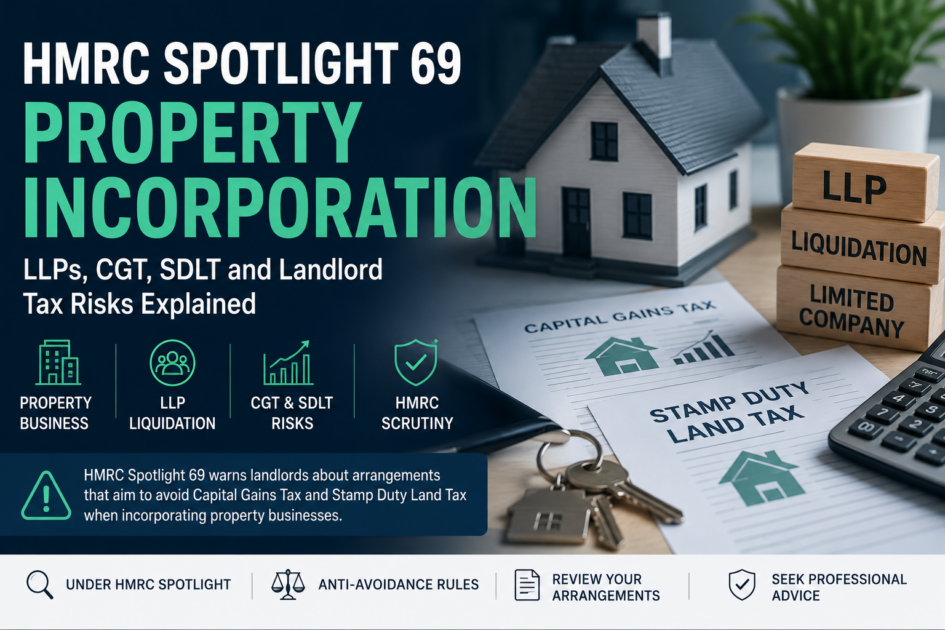
In light of HMRC Spotlight 69 property incorporation, landlords must approach the incorporation process with caution to avoid pitfalls.
On 28 April 2025, HMRC published Spotlight 69, titled Liquidation of a Limited Liability Partnership used to avoid Capital Gains Tax. The Spotlight targets arrangements where landlords transfer property into an LLP, place the LLP into members’ voluntary liquidation, and then move the property into a limited company connected with the same landlords. HMRC’s clear view is that these arrangements do not work and may result in tax, interest and penalties.
It is vital for landlords to understand the implications of HMRC Spotlight 69 property incorporation before making decisions that could affect their tax obligations.
Landlords should be aware of the implications of HMRC Spotlight 69 property incorporation when considering their tax strategies.
HMRC Spotlight 69 property incorporation can have significant tax implications that landlords must consider.
Why Are Landlords Incorporating Property Businesses?
Understanding HMRC Spotlight 69 Property Incorporation
Over recent years, many residential landlords have faced higher tax costs, mainly because mortgage interest relief for personally held residential property has been restricted. Instead of receiving full deduction for finance costs against rental income, individual landlords usually receive only a basic rate tax credit.
By contrast, a company carrying on a property rental business may generally deduct finance costs under corporation tax rules, subject to the usual rules and restrictions. This has made incorporation attractive for some landlords, particularly those with larger portfolios, higher borrowing, or long-term succession planning objectives.
Understanding HMRC Spotlight 69 property incorporation is essential for proper tax planning.
However, transferring personally held properties into a company can trigger two major tax charges:
- Capital Gains Tax, if the properties have increased in value; and
- Stamp Duty Land Tax, because the company may be treated as acquiring the properties at market value.
This is where some marketed schemes have attempted to use LLPs as an intermediate step.
It is crucial to navigate HMRC Spotlight 69 property incorporation carefully to avoid triggering unexpected tax liabilities.
What Was the LLP Incorporation Scheme?
In simple terms, the scheme usually involved the following steps:
- The landlords claimed to operate a property business as a partnership.
- The property business and properties were transferred into an LLP.
- The LLP was then placed into members’ voluntary liquidation.
- The properties were transferred from the LLP to a limited company owned by the same landlords or connected parties.
- The arrangement claimed to avoid or reduce CGT and SDLT on the incorporation.
The attraction of the scheme was that it appeared to use the tax transparency rules for LLPs to avoid triggering an immediate CGT charge, while also seeking to use partnership SDLT rules to avoid a full SDLT charge.
Landlords should be aware that HMRC Spotlight 69 property incorporation does not provide a foolproof way to avoid taxation.
HMRC disagrees with this analysis.
HMRC’s View: The Scheme Does Not Work
HMRC Spotlight 69 property incorporation highlights the risks associated with certain tax avoidance schemes.
HMRC has stated that these arrangements are tax avoidance and that users may have to pay the tax they tried to avoid, together with interest and penalties. HMRC has also indicated that it may use existing anti-avoidance provisions, including the General Anti-Abuse Rule where appropriate, for earlier arrangements.
This is particularly important because some landlords may have entered into these arrangements after receiving promotional advice from scheme providers. Advice from a promoter is not always treated as independent, reliable advice for penalty protection purposes.
New Capital Gains Tax Rule: Section 59AA TCGA 1992
A key development is the introduction of section 59AA into the Taxation of Chargeable Gains Act 1992. HMRC announced that legislation would be introduced to counter these LLP liquidation arrangements, with effect from 30 October 2024.
In broad terms, where a member contributes property to an LLP and the LLP is later liquidated, the new rule can treat the member as having disposed of the property at market value when it was contributed to the LLP. The gain is then treated as accruing when the LLP disposes of the asset.
The practical effect is that the historic gain that the scheme sought to remove may still be taxed.
SDLT Risks Should Not Be Ignored
The SDLT position is also risky. Where property is transferred to a company connected with the landlord, SDLT can often be charged by reference to market value. Some schemes have attempted to rely on partnership rules to reduce or eliminate SDLT.
Understanding the risks of HMRC Spotlight 69 property incorporation can help landlords make informed decisions.
HMRC’s view is that SDLT anti-avoidance provisions may apply, particularly where there is a pre-planned series of steps designed to move property into a company while avoiding SDLT. In such cases, HMRC may seek to apply the rules so that the company is treated as acquiring the property for market value consideration.
This means landlords could face a substantial SDLT liability, even where the paperwork was designed to show nil or reduced consideration.
Incorporation Relief Is Different From an Avoidance Scheme
HMRC Spotlight 69 property incorporation should not be confused with legitimate tax planning strategies.
It is important not to confuse marketed LLP liquidation schemes with genuine property business incorporation planning.
There can be legitimate cases where incorporation relief under section 162 TCGA 1992 may be available. However, the conditions are strict. A property letting activity must amount to a genuine business, not merely passive investment activity. The landlord’s level of activity, management involvement, record keeping, commercial purpose and overall facts will matter.
In many cases, incorporation relief is not straightforward and should not be assumed.
What Should Landlords Do Now?
Landlords should take extra care before moving properties into a company. Incorporation may still be commercially sensible in some cases, but it must be reviewed properly and not treated as a simple tax-saving exercise.
Before proceeding, landlords must consider the long-term effects of HMRC Spotlight 69 property incorporation on their business.
Before taking any action, landlords should consider:
- whether there is a genuine property business rather than passive investment ownership;
- the likely CGT position;
- the SDLT cost of transferring the properties;
- mortgage refinancing and lender consent;
- legal costs and conveyancing;
- company compliance costs;
- inheritance tax and succession planning;
- whether the long-term tax saving justifies the upfront tax and professional costs.
What If You Have Already Used an LLP Scheme?
If you have already used an LLP liquidation or similar property incorporation scheme, you should seek professional advice as soon as possible. HMRC has made clear that it may recover tax, interest and penalties from users of the scheme.
If you are affected by HMRC Spotlight 69 property incorporation, seeking professional advice is paramount.
A voluntary disclosure may help reduce penalty exposure compared with waiting for HMRC to open an enquiry or raise a discovery assessment. The correct approach will depend on the facts, the dates, the documents signed, the tax returns submitted, and whether HMRC has already made contact.
KSM’s View
Professional guidance on HMRC Spotlight 69 property incorporation can ensure that your strategy aligns with current tax laws.
For landlords with larger property portfolios, the right answer is usually not a template scheme. A proper review should consider CGT, SDLT, corporation tax, income tax, inheritance tax, refinancing, legal ownership, family succession and long-term business plans.
At KSM Chartered Certified Accountants and Tax Advisors, we help landlords and property investors assess whether incorporation is commercially and tax-efficiently appropriate. We also assist with reviewing existing arrangements where landlords are concerned about HMRC Spotlight 69 or previous LLP-based advice.
Need Advice on Property Incorporation?
If you are a landlord considering transferring your property portfolio into a limited company, or if you have already used an LLP structure and are concerned about HMRC’s position, contact KSM for a confidential review.
For those exploring the implications of HMRC Spotlight 69 property incorporation, KSM offers expert consultations.
KSM Chartered Certified Accountants and Tax Advisors
Website: www.theksma.co.uk
Email: info@theksma.co.uk
Telephone: 020 8672 3411
Disclaimer
This article is for general information only and does not constitute tax, legal or investment advice. Property incorporation and LLP structures can have significant CGT, SDLT, income tax, corporation tax, inheritance tax, legal and financing consequences. Professional advice should be taken before implementing or reviewing any arrangement.
This article aims to clarify the complexities surrounding HMRC Spotlight 69 property incorporation for landlords.


This article is general guidance only and does not constitute tailored tax advice. Please contact KSM Consulting Ltd for advice based on your circumstances.